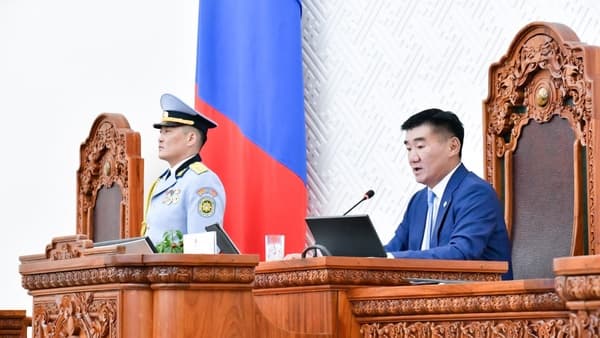
ECONOMIC FREEDOM LAW PASSED
orgil orgil
Verified Editorial
Mongolia has passed its landmark Law on Economic Freedom as part of PM N. Uchral’s economic liberalization agenda. Although the law slashes withholding taxes and streamlines digital permits, international investors caution that its real impact on mining licensing and FDI inflows remains to be seen, pending deeper judicial updates and stalled state-owned enterprise (SOE) reforms.
On July 3, 2026, the Parliament of Mongolia officially passed the landmark Law on Economic Freedom along with an accompanying legislative package amending 97 other interconnected laws. This sweeping legal reform serves as the absolute cornerstone of Prime Minister N. Uchral’s economic liberalization agenda, famously dubbed the “100 Liberations in 100 Days” policy initiative. The primary objective of the law is to aggressively expand the operating space for the private sector, reinforce investor protection, and digitize the bureaucratic framework by reducing standard permit requirements by up to 60 percent. Furthermore, to revitalize capital markets, the law slashes the withholding tax rate on interest income from foreign and domestic debt instruments from 20 percent to 5 percent, a move that has captured significant international attention. However, domestic and foreign investors, alongside global observers, are approaching the passage of this law with a blend of cautious optimism and deep-seated skepticism.
While the new legislation outlines highly favorable parameters on paper, it remains entirely ambiguous how the actual issuance of mining licenses and exploration permits will be accelerated in practice. Businesses are closely monitoring whether the notorious bureaucratic gridlock within state agencies and actual decision-making timelines will genuinely decrease. Additionally, the continued weakness in the independence and effectiveness of the judiciary—the most critical foundation for sustainably attracting foreign direct investment (FDI)—remains a primary source of investor anxiety. Analysts repeatedly warn that no matter how progressive a law appears on paper, it cannot yield tangible macroeconomic results without a fully functioning court system capable of robustly protecting property rights and impartially resolving contract disputes. Beyond that, the continuous stalling of structural reforms and privatization initiatives for heavily inefficient State-Owned Enterprises (SOEs) remains a massive roadblock to cleaning up the broader investment climate.
The heavy dominance of state-owned entities within the strategic mining sector continues to stifle free-market competition and severely restrict high-value private-sector partnerships. Consequently, whether the Law on Economic Freedom can trigger a genuine turning point for mining licensing bottlenecks and foreign capital inflows depends entirely on its practical enforcement over the coming months. Major industry associations and international observers note that it is far too early to gauge the law's ultimate efficacy, a sentiment strongly echoed by the prominent analysis bureau "Mongolia Weekly." Investors are demanding concrete manifestations of the rule of law and thorough judicial overhauls rather than purely declarative legislative texts. Granted, the government deserves credit for incorporating highly progressive clauses, such as recognizing digital businesses and allowing foreign nationals to operate seamlessly without physical residency constraints.
Nevertheless, persistent uncertainties regarding how state oversight will shift concerning long-term contracts in the strategically vital mineral extraction sector continue to cause hesitation among foreign financiers. The Ministry of Economy and Development has long acknowledged that Mongolia's FDI inflows have been highly volatile over the past 15 years, overly reliant on a handful of mega-projects. While the new law is theoretically designed to break this instability and foster non-mining economic diversification, doubts persist over whether the deep-seated attitudes of mid-level bureaucratic officials will adapt to these changes. Certain government agencies continue to create administrative bottlenecks by misinterpreting legislative acts and unnecessarily extending permit processing durations. Therefore, time will tell whether Prime Minister N. Uchral’s declaration of economic liberation will materialize into a transformative investment landscape or remain a mere political slogan. Ultimately, while the new law is a commendable stride toward drawing long-term mining capital, its true success hinges on simultaneous, aggressive execution of judicial and state-owned enterprise reforms.